Monday, February 27, 2012

PQ leads by one. Or nine?

A CROP poll released last week got quite a bit of attention as it placed the Parti Québécois narrowly ahead of Jean Charest's Liberals. Another poll that I noticed today on Forum's website shows that the PQ leads by nine points over the Liberals and that François Legault's CAQ has dropped to only 19% support.

In my article for The Globe and Mail today I combined the Léger and CROP polls to make a more well-rounded projection of the situation in Quebec. You can read it here.

I wrote about the Forum poll for Le Huffington Post Québec here. The article is in French. I think I was the first person to notice the poll, or at least write about it, as I can't find any mention of it elsewhere.

CROP was last in the field January 17-21, and since then the Parti Québécois has picked up a whopping nine points to lead with 30%. Though this shows a huge gain in support for the PQ, CROP's polling was well below what Léger was finding, so it is more likely that the PQ at 21% in CROP's last poll was at the lower end of the margin of error.
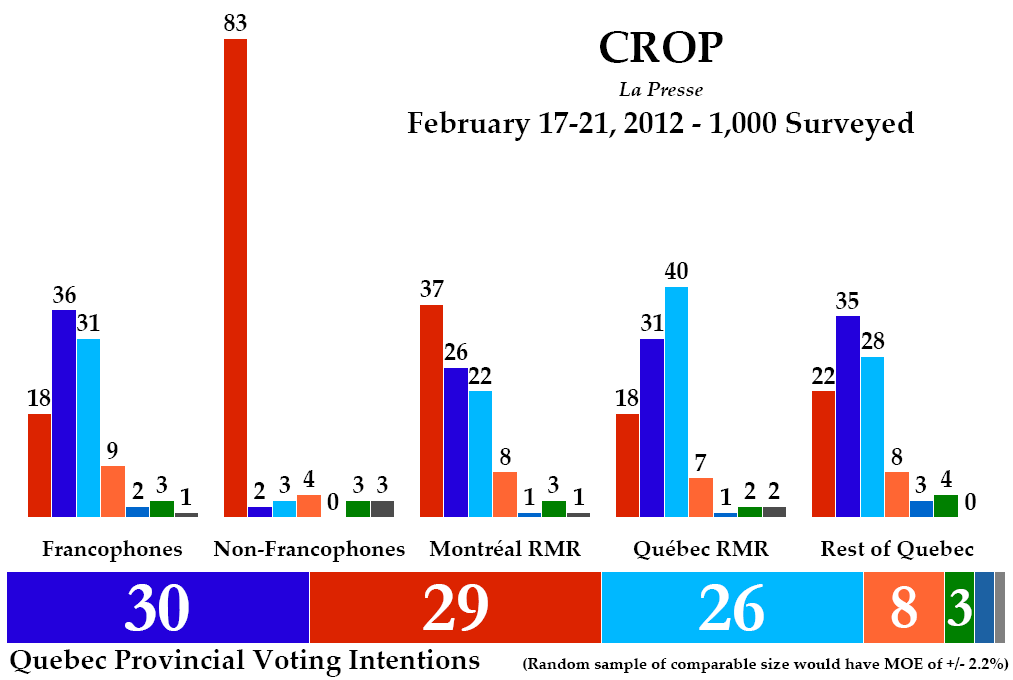
The Liberals are unchanged at 29%, while the CAQ is down five points to 26%.

Québec Solidaire is down three points to 8% while the Greens are down two to 3%. Option Nationale is unchanged at 2%.

The Parti Québécois leads in the regions of Quebec with 35%, up 15 points since mid-January. They are second in Quebec City with 31% (+13) and in Montreal with 26% (+4).

The Liberals lead in Montreal with 37% (+8) but are trailing in third in Quebec City with 18% (-8) and the rest of  Quebec with 22% (-8).

The CAQ leads in Quebec City with 40% (-1), is second in the regions with 28% (-3) and is third in Montreal with 22% (-7).

The PQ is up 12 points to 36% among francophones, while the CAQ and Liberals are down three points apiece to 31% and 18%, respectively.

Jean Charest and François Legault are tied at 21% on the leadership question, while Pauline Marois is close behind with 19%. Support for sovereignty was at 39% in this poll.

With these numbers, the Parti Québécois would form a minority government with 55 seats. The Liberals would win 39 seats and the CAQ 29, with two seats going to Québec Solidaire (both in Montreal).

The PQ wins 13 seats in and around Montreal, four in Quebec City, and 38 in the rest of Quebec.

The Liberals win 34 seats in and around Montreal, none in Quebec City, and five in the rest of Quebec.

The CAQ wins nine seats in and around Montreal, seven in Quebec City, and 13 in the rest of Quebec.

In other words, this poll is very similar to Léger's and shows the same sort of battle evolving: Liberals in Montreal, CAQ in Quebec City, PQ everywhere else. But increasingly we're seeing that the PQ is going to be able to challenge the Liberals in and around Montreal and the CAQ in the suburbs of the city, meaning that the PQ is best placed to form government.

Now to the Forum poll, which argues that the PQ is back to where it was in early 2011.
As far as I can tell, Forum hasn't waded into the provincial scene in Quebec before. This is their first Quebec poll, and it is quite an unusual one - or at least compared to what other polls have shown.

Forum has the Parti Québécois at 39% to 30% for the Liberals, 19% for the CAQ, and 6% for Québec Solidaire.

The poll, however, was conducted on February 23. That was the same day that La Presse published the new CROP poll that put the CAQ in third place, four points behind the leading PQ. It is unlikely that this news could not have had a big effect on the poll, and this is always a danger when polls are conducted on one day only.

Nevertheless, the Parti Québécois leads in Montreal with 35% and on the "North Shore" (47%) and "South Shore" (46%). I've tried to find out how exactly Forum defines these regions, but I assume it is the Montreal and Quebec City CMAs with the North/South shores representing those areas north and south of the Ottawa and St. Lawrence Rivers. The PQ is second in Quebec City with 30%.

The Liberals lead in Quebec City with 33% and are second in Montreal (33%), the north shore (27%) and the south shore (24%).

The CAQ is in third across the board, with 18% support in Montreal and the north shore, 19% support on the south shore, and 26% in Quebec City.

Forum gives the PQ a huge lead among francophones: 43% to 25% for the Liberals and 21% for the CAQ.

Jean Charest has the worst approval rating at 28% to 61% disapproving, a negative 33 rating. François Legault splits at 31% to 42% for a negative 11 rating, while Pauline Marois has 38% approval to 47% disapproval, for a net -9.

Forum put a twist on the usual sovereignty question, giving respondents four options. They are somewhat differently worded compared to what you usually see in Quebec polls, but boil down to sovereignty, sovereignty-association, distinct society, and status quo.

A majority chose the first two options (26% sovereignty, 25% sovereignty-association) while 20% chose a distinct society and 24% the status quo. Of PQ voters, 78% chose the first two options while 71% of Liberal voters chose the last two options. The CAQ was divided every which way: 17% sovereignty, 29% sovereignty-association, 26% distinct society, 25% status quo.

There are many ways to read this. Support for sovereignty among CAQ supporters could be read as 17% or as much as 46%. Or support for a change of status of some sort hits 72%. On the other hand, support for a future aligned with Canada among CAQ supporters is 80%. These numbers can be spun in any number of ways.
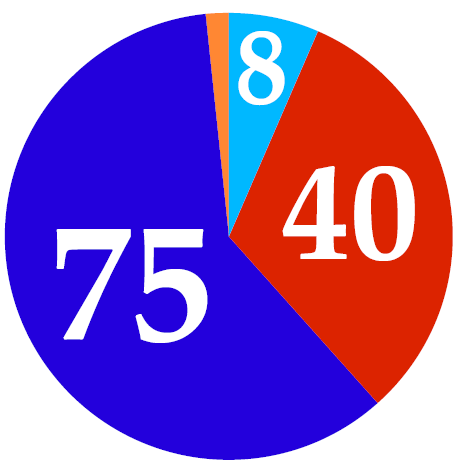
Assuming that Forum divides the province geographically as I've spelled out above, this poll would deliver 75 seats to the Parti Québécois and a majority government. The Liberals would win 40 seats and the CAQ only eight - one fewer than they have right now. Québec Solidaire wins two seats, both in Montreal.

Regionally, the PQ wins 28 seats in Montreal, two in Quebec City, and 45 in the rest of Quebec.

The Liberals win 28 seats in Montreal, six in Quebec City, and six in the rest of Quebec.

The CAQ wins no seats in Montreal, three in Quebec City, and five in the rest of Quebec.

So instead of a PQ minority and a respectable third-place showing for the CAQ, Forum sees a PQ majority and a disaster for François Legault. I imagine the truth is somewhere in between, but that a poll can produce such a result indicates just how soft the CAQ's support truly is and that Legault is fighting Marois for the hearts and minds of fence-sitting Quebecers, not Charest. Jean Charest looks to be stuck at around 30% and has a solid base, which is not a horrible position for the strong campaigner. He could turn that into 35% and squeak out another victory, but the campaign could turn against him and the PQ could romp to a majority win.

This might all be resolved in a matter of months if Jean Charest calls an election. But if he doesn't, and we have to wait until the fall or the spring of 2013 for a resolution, the roller coaster ride will continue.

Friday, February 24, 2012

NDP leads in Quebec in CROP polling

No, this isn't a re-post of the infamous CROP poll that came out during the campaign, marking the beginning of the NDP's rise in the province. But considering that the last poll we saw coming out of Quebec put the NDP in second behind the Liberals, it is worth noting that they are still on top according to CROP.
CROP was last in the field January 19-23, and since then the New Democrats have gained two points to sit at 31%, just above the psychological bar of 30%. It is also, in my estimation, an important bar for seats. Once the NDP drops below 30%, they start to lose seats in bunches.

The Bloc Québécois is up two points to 24%, while the Conservatives are down two to 22%. The Liberals are up one to 20%.

This might seem to completely dispel the most recent Forum poll which put the Liberals ahead in the province. While the poll certainly has the Liberals at a lower mark in Quebec, it is nevertheless the best result for the Liberals in a CROP poll since October 2010. It seems safe to say, then, that the Liberals are doing relatively well in Quebec.

This 24% is also the highest that the BQ has registered in CROP's polling since the May 2011 election, while the 30% satisfaction rating of the Conservative government is the lowest since April of last year.

In the all-important francophone demographic, the New Democrats hold a narrow edge over the Bloc with 31% to 29%, a net gain of two points for the Bloc on the NDP since the end of January. The Conservatives are down one to 19% while the Liberals are unchanged at 17%.

With the small sample sizes of non-francophones, wide variations are to be expected: the NDP has gained 10 points in this demographic since January while the Tories have lost 13. But it is interesting to note that the three parties are virtually neck-and-neck. It makes the West Island a bit of a free-for-all, with a possibility that all three parties could win a seat on the island.

But in the Montreal region as a whole, the New Democrats are up four points and lead with 33%. The three other parties are tied at 22%, but that is a gain of three points for the Liberals and a drop of one for the Tories and two for the Bloc.

In Quebec City, the Conservatives are down one but still comfortably lead with 37%. Their closest rival, the NDP, is down two points to 23% while the Bloc is up five to 20%. This is actually very bad news for the New Democrats, as CROP's definition of Quebec City does not extend to the Lévis area where the Tories hold their seats. In other words, the NDP risks being swept from Quebec City with these numbers.

In the rest of the province, the NDP is up one to 31% while the Bloc is up five to 27%. The Liberals and Conservatives are tied at 19%, with the Tories dropping four points.

This would likely result in the New Democrats winning 41 seats on the current 75-seat map, with the Liberals winning 13, the Conservatives 12, and the Bloc Québécois nine.

While 48% of Quebecers were undecided or responded "none of the above" on who is best suited to be Prime Minister, 19% of Quebecers feel that Stephen Harper is the best option. Liberal Bob Rae comes up a close second with 16%, despite his interim status. By comparison, Nycole Turmel (a francophone Quebecer to boot) scores only 8%. Daniel Paillé registered 7%, his highest so far and the highest any Bloc leader has polled (whether undefined or identified as Vivian Barbot, who was president of the party) since Gilles Duceppe's resignation. His numbers are still well below Duceppe's, but he appears to be gaining a little bit of traction.

This poll breaks a streak of four consecutive surveys pegging NDP support at below 30% in the province, which is good news for the party. That they hold a seven point edge over their nearest rival is also positive, after trailing in one recent poll and leading the Bloc by only one point in another. They are still not out of the woods, however, as they are losing ground to the Bloc Québécois among francophones and it does not appear that they are in a position to hold on to Quebec City. That is nothing new - they haven't lead in the region in any Léger or CROP poll since November.

New Democrats should keep the champagne cork in the bottle for now. Since the election, CROP has generally pegged NDP support higher than other polls taken at around the same time. Their NDP numbers have been, on average, about 3.3 points higher. Whether CROP is on the money while the others are incorrect is certainly possible, and CROP has often been closer to Léger's polling than those of the other firms that are not Quebec-based and poll nationwide, but it would appear that CROP is probably near the high range of likely NDP support in Quebec.